You open a spreadsheet every morning, copy numbers from Stripe, paste them into Google Sheets, then write a report email for your team. This process has two fundamental problems: it's slow and it's backward-looking. By the time you notice churn is climbing, those customers left three weeks ago.
AI doesn't just track numbers — it reads signals. And across these 10 metrics, that difference separates timely action from watching a crisis unfold in slow motion.
Three core reasons AI beats spreadsheets:
- Real-time, not weekly snapshots: AI processes continuously, not waiting for Monday's standup.
- Multi-dimensional pattern detection: Humans spot obvious trends. AI catches subtle correlations — like: users who activate Feature A in week one have 70% retention at 6 months.
- Predictive, not just descriptive: Instead of "churn this month is 8%," AI says "80% probability Account X churns within 2 weeks."
The 10 Metrics — And Why AI Does Them Better
1. MRR (Monthly Recurring Revenue)
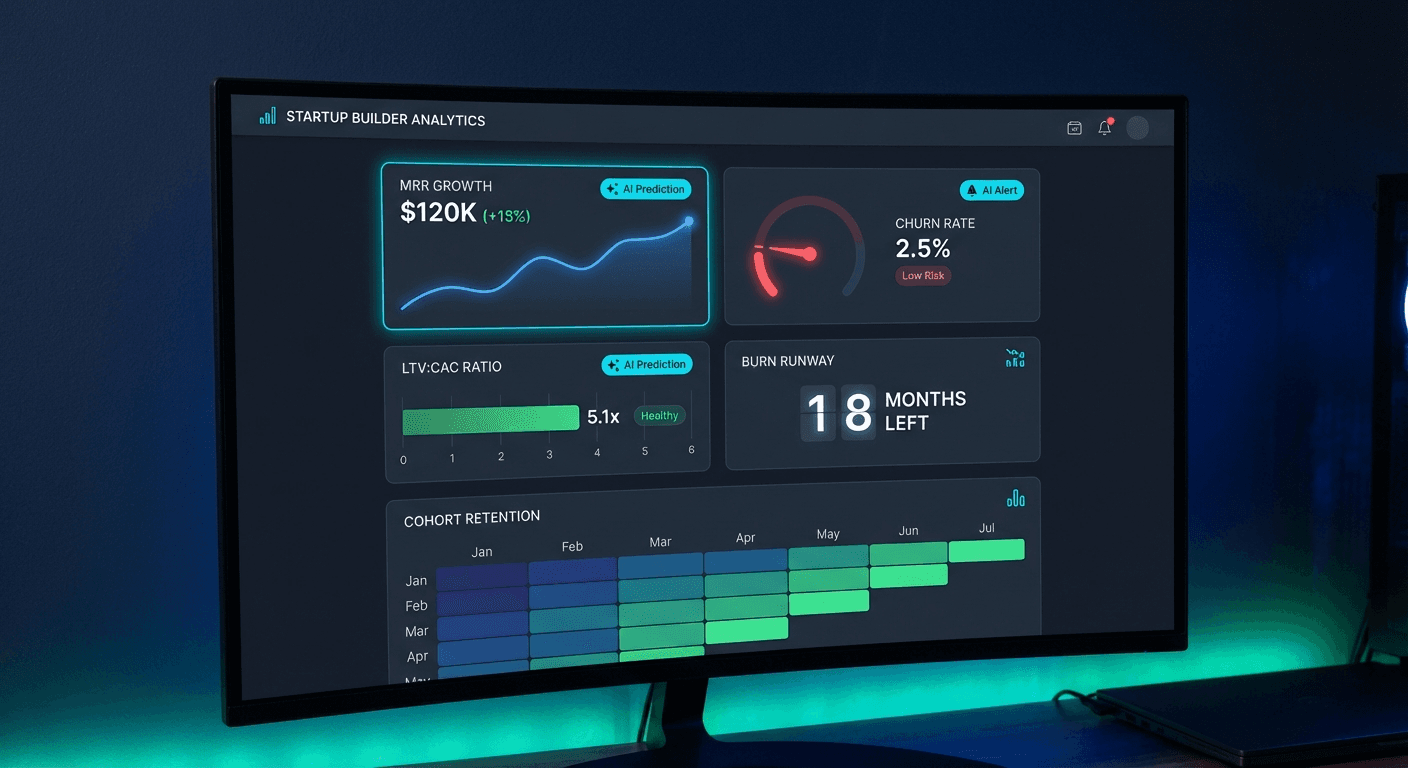
Most founders look at total MRR. AI splits it into four streams: New MRR (new customers), Expansion MRR (upgrades), Contraction MRR (downgrades), Churned MRR (cancellations). When Expansion MRR grows but Churned MRR grows faster, AI alerts you before total MRR starts declining. Forecast accuracy for next month's MRR typically lands within 5% error.
2. Churn Rate
This is where AI creates the biggest gap versus manual tracking. AI detects pre-churn signals 2–3 weeks before a customer actually cancels. Pattern example: login frequency down 40% over 2 weeks + no email opens + core feature unused = red alert. You have time to intervene — run a win-back campaign, schedule a CSM call, or offer a retention deal.
3. CAC (Customer Acquisition Cost)
Last-click attribution is lying to you. A customer reads your blog, sees a retargeting ad, asks a colleague, then signs up. AI performs multi-touch attribution — distributing credit accurately across every touchpoint in the purchase journey. Real CAC per channel often differs 30–50% from last-click reports, leading to systematically wrong budget allocation decisions.
4. LTV (Customer Lifetime Value)
Most startups calculate LTV with a static formula: ARPU ÷ Churn Rate. AI calculates predictive LTV from cohort behavior — which signup month, which plan, which features used in the first 30 days. LTV updates daily and segments by customer type, not a single average across your entire customer base.
5. LTV:CAC Ratio
The healthy threshold is 3:1. When the ratio drops below that, AI doesn't just alert — it traces the cause. Which channel is driving CAC up? Which segment is pulling LTV down? This is the difference between a passive dashboard and an active analyst.
Quarterly NPS surveys give you a snapshot every 3 months — far too slow. AI analyzes continuous sentiment from support tickets, email replies, and app store reviews, updating your effective NPS weekly. When NPS drops 10 points in two weeks, you know immediately and can trace the cause, rather than discovering it next quarter.
7. Activation Rate
Not all signups are equally valuable. AI finds the "magic moment" — the specific onboarding action that predicts 70–80% retention at 90 days. This lets you optimize your onboarding flow based on actual behavioral data, not guesswork or random A/B tests.
8. Revenue per Employee
The most important operational efficiency metric for scaling stages. When revenue grows slower than headcount, AI flags diminishing returns from team expansion — a signal to optimize processes and tooling before continuing to hire.
9. Burn Rate & Runway
AI forecasts runway based on actual burn trends, not just the current month's burn. If burn is increasing 15% month-over-month, your real runway is significantly shorter than a simple calculation suggests. Automated alerts fire at the 9-month, 6-month, and 3-month runway marks — giving you time to fundraise or cut costs before it becomes an emergency.
10. Cohort Retention
This is the most reliable Product-Market Fit indicator. If your Month 1 cohort retains 60% at 3 months but your Month 6 cohort retains only 40%, AI detects PMF erosion before it hits total revenue. The warning sign: your product works well for early adopters but is losing relevance as you expand to a broader market.
4-Week Implementation Roadmap
| Phase | Priority Metrics | Suggested Stack |
|---|
| Week 1 | MRR, Churn, Burn Rate | Stripe + Metabase or Redash |
| Week 2 | CAC, LTV, Activation Rate | Mixpanel + LLM pipeline |
| Week 3 | NPS, Cohort Retention | Segment + custom analysis |
| Week 4 | Revenue/Employee + LTV:CAC alerts | Full AI monitoring |
Starting principle: Begin with the metric closest to revenue — MRR and Churn Rate. Once your data pipeline is stable, layer in predictive metrics. Don't try to instrument all 10 at once.
AI doesn't replace founder judgment. But it eliminates what drains the most time and energy: staring at numbers without knowing what they're warning you about.
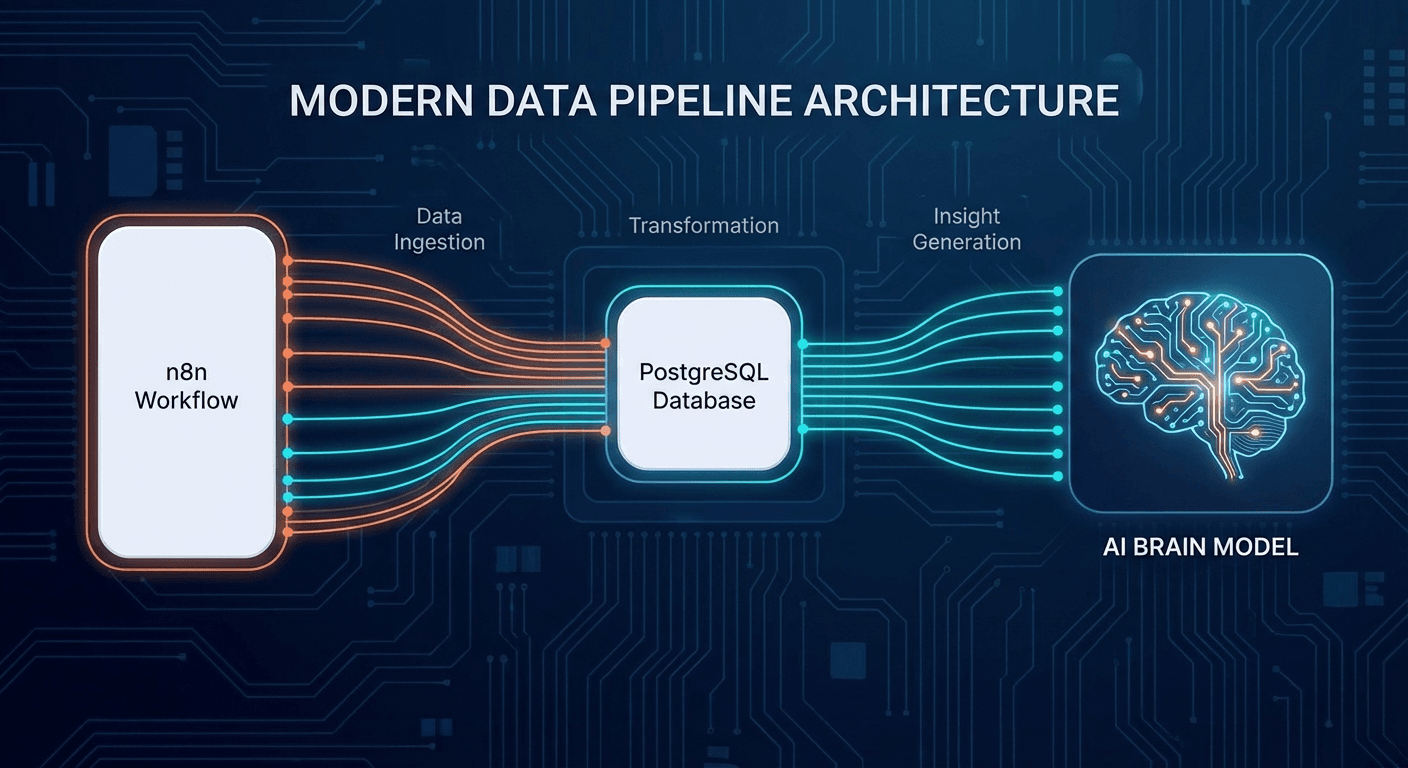
See how to build an automated data pipeline with n8n and Postgres to connect your data sources, or set up Human-in-the-Loop AI Agents to stay in control of your automated decisions.