OpenCog Hyperon & ASI Alliance: The Real AGI Roadmap Beyond OpenAI
AtomSpace Hypergraph Architecture, MeTTa Language, and the Fundamental Question: Can Neural-Symbolic Beat Deep Learning?
At a Glance
Deep technical analysis of OpenCog Hyperon (AtomSpace hypergraph, MeTTa language, PLN, ECAN, MOSES), real progress to PyPI 0.2.10 (02/2026), ASI Alliance drama (Ocean Protocol withdrawal 10/2025, ASI token -96% from peak), and honest assessment of AGI roadmap vs OpenAI/DeepMind.
OpenCog Hyperon & ASI Alliance: The Real AGI Roadmap
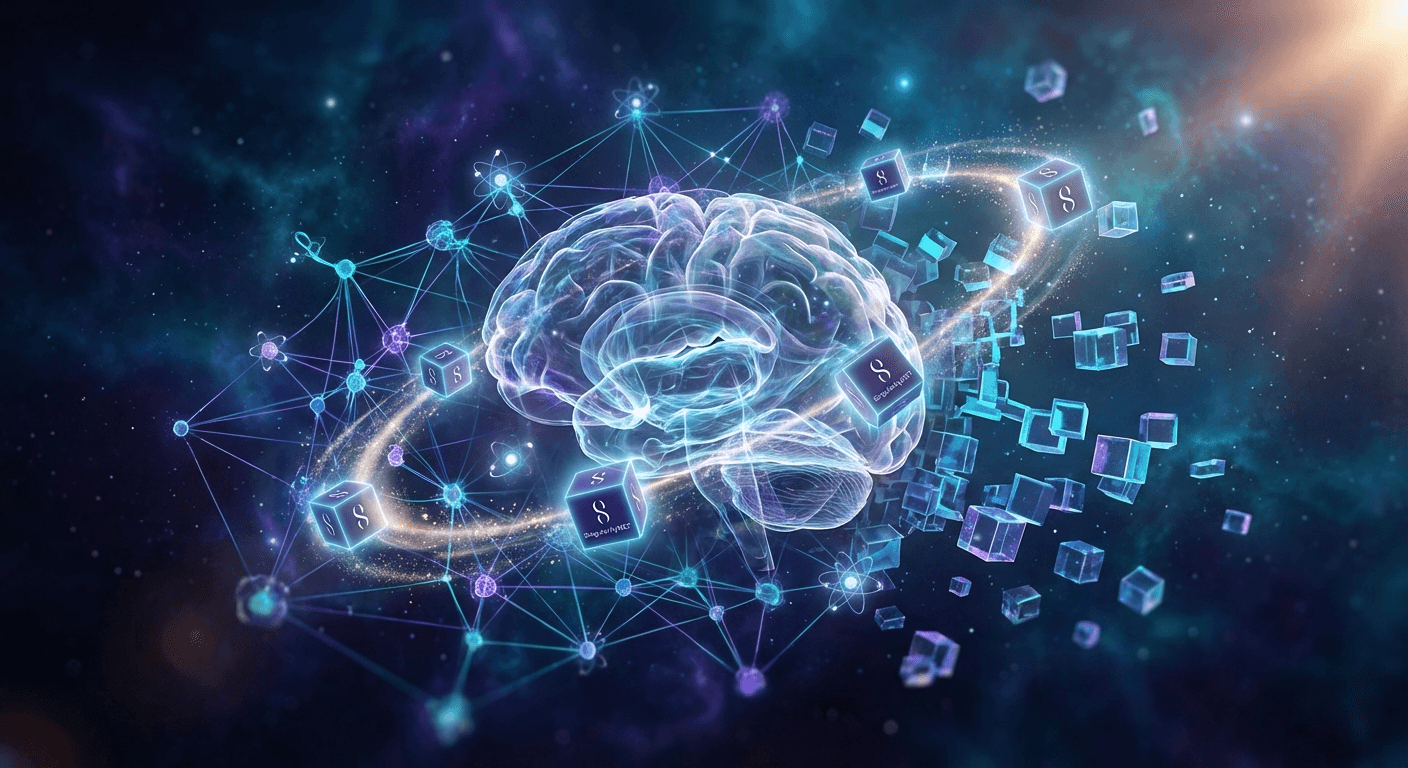
While OpenAI pours billions into scaling laws, Ben Goertzel — the scientist who coined "AGI" in 2001 — is building OpenCog Hyperon: an architecture combining symbolic logic, probabilistic networks, and evolutionary algorithms. The core question: what does real intelligence require beyond pattern matching?
From OpenCog Classic to Hyperon
OpenCog Classic launched in 2008 (C++, monolithic). In 2021, Goertzel rebuilt it from scratch as Hyperon for three reasons: the old architecture couldn't be distributed, it needed to integrate LLMs as a cognitive module (not replace everything), and it needed MeTTa — a new language purpose-built for AI-native semantics.
Five Core Components
AtomSpace Hypergraph: Knowledge graph where each hyperedge connects any number of nodes (not just 2 like RDF/OWL). Naturally represents complex contexts, self-reference, and multi-dimensional relationships — things vector embeddings can't do systematically. Supports distributed storage via IPFS and blockchain (DAS).
MeTTa: A new language combining pattern matching, functional programming, and graph rewriting. Standout features: self-modifying code (programs rewrite their own inference rules) and grounded atoms (neural network outputs become atoms in AtomSpace). PyPI hyperon 0.2.10 released 11/02/2026 — consistent cadence confirms an active project.
PLN (Probabilistic Logic Networks): Inference with truth values as (strength, confidence). Example: P(A→B)=(0.9, 0.8) + P(B→C)=(0.8, 0.7) → P(A→C)=(0.72, 0.56). Not binary true/false, not statistical correlation — belief updating based on evidence, like Bayesian inference.
ECAN (Economic Attention Networks): Cognitive resource allocation through an internal "attention economy." Each atom competes for STI/LTI (Short/Long-Term Importance). Predates Transformer attention by nearly a decade (2008 vs 2017), and operates on knowledge graphs rather than token sequences.
MOSES: Evolutionary search finds programs (not weights) — interpretable and sample-efficient. Originally applied to genomics and medical data, where explainability is a hard requirement.
ASI Alliance: Ambition, Drama, Reality
March 27, 2024: SingularityNET + Fetch.ai + Ocean Protocol announced merging tokens into ASI. Conversion rates: FET 1:1, AGIX and OCEAN at 0.433:1 each.
October 2025: Ocean Protocol withdrew. Core reason: business model conflict — OCEAN tokenomics were specifically designed for a data marketplace (burn, staking, dataset curation), and merging into ASI broke these mechanics. ASI Alliance is now only SingularityNET + Fetch.ai.
Related Resources
Comments (0)
Loading comments...
Stay Updated
Get weekly insights on AI, automation, and shipping fast. Join 500+ founders.
Related Articles

API Proxy vs. Antigravity: The Legitimate Path and the Dangerous Shortcut
API proxies and Antigravity both promise cheaper AI — but the mechanics are completely different. One is an official reseller, the other borrows OAuth tokens in violation of ToS. In February 2026, Google acted. Here's the analysis you need before making a choice.
API Proxies & Aggregators: Use Premium AI at Optimal Cost
Managing a dozen separate API accounts is every AI builder's nightmare. Proxies and aggregators solve it cleanly: one key, one endpoint, every model — with a breakdown of OpenRouter, Z.AI, LiteLLM, and Helicone.

Mastering API Keys: Your Gateway to AI Power
API Keys are the bridge between your applications and AI power. This guide covers everything from how they work, to getting keys from OpenAI, Google Gemini, Anthropic Claude, and DeepSeek — and how to use them securely.