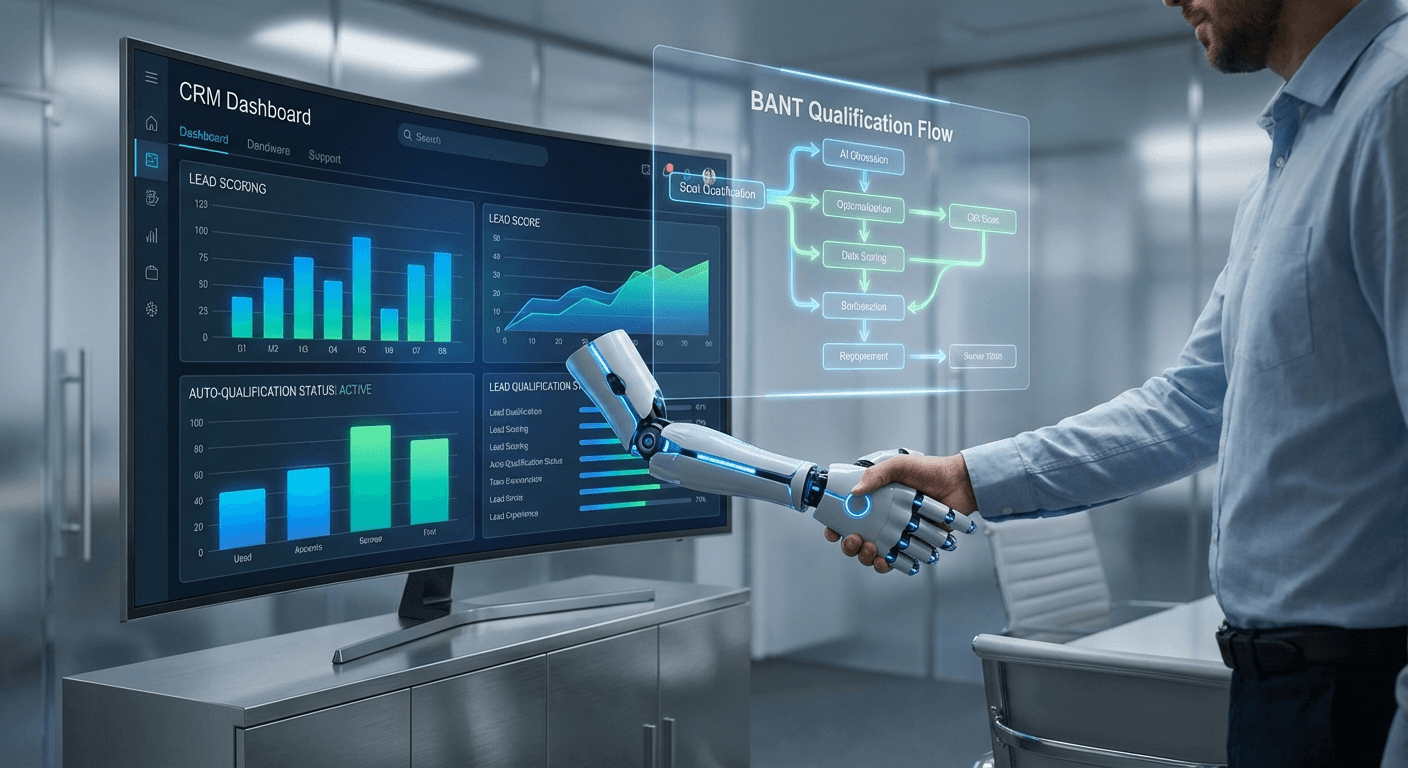
You've used ChatGPT to write emails or summarize documents. But at some point you thought: "Can AI do more than just answer questions? Can it actually work for me?"
The answer is yes — and that's called an AI Agent.
What Is an AI Agent? No Jargon, No Code Required
Picture two types of employees:
Employee A sits in a room and only responds when you ask something. Incredibly knowledgeable, but completely passive. That's ChatGPT.
Employee B is your sharp new intern. You hand them a goal: "Find 20 real estate leads and send them a personalized introduction email." They research on their own, filter the list, craft a unique message for each person, and report back with results. That's an AI Agent — proactive, self-directed, and tool-savvy.
Technically speaking: an AI Agent is a software system that can autonomously identify goals, plan, and take actions to complete tasks — without a human guiding every single step.
The Sense–Think–Act Loop: The AI Agent's Brain
Every AI Agent operates on a 4-step cycle called the Agent Loop:
1. Perceive (Sense)
The agent gathers information from its environment: reading a new email, receiving a Zalo message, detecting new rows in a Google Sheet, or monitoring real-time price data.
2. Reason (Think)
This is what separates agents from traditional automation. The agent uses an LLM to analyze the situation:
"Is this email a complaint or a price inquiry? What do I need to do? Should I look up the refund policy?"
Then it formulates a specific action plan.
3. Execute (Act)
The agent carries out the plan using "tools" — sending a Slack message, updating the CRM, searching Google, creating a purchase order in the ERP, or calling an accounting API.
4. Learn (Reflect)
After acting, the agent reviews its results. If something fails, it self-corrects: "Email delivery failed — try the alternate address." This self-recovery capability is completely absent from traditional automation.
AI Agent vs ChatGPT vs Automation: Stop Confusing Them
| Legacy Automation | ChatGPT | AI Agent |
|---|
| Nature | Rule-based execution | Content generation | Goal-oriented action |
| Mechanism | If A → do B | Ask A → answer B | Want A → find path B, C, D |
| Flexibility | Low (breaks on errors) | High (creative) | Very high (adaptive) |
| Example | Save email attachments to Drive | Write an apology email | Read complaint → check stock → issue refund → send apology → report to manager |
| Role | Assembly line worker | Consultant/Secretary | Autonomous employee |
As Andrew Ng famously pointed out, the defining feature of Agentic AI is "iterative refinement": the ability to reason, self-correct, and improve to reach the best outcome — rather than just producing an immediate answer.
📖 Learn more about this evolution: From Chatbot to AI Agent: The Journey
Business Benefits: Why AI Agents Are the Future of Productivity
Reports from McKinsey and Gartner in 2025 confirm it: AI Agents are the next leap after Generative AI. This isn't a trend — it's a structural shift.
Productivity Beyond Human Limits
- Complex task automation: Traditional automation only handled simple steps. AI Agents now tackle workflows requiring judgment — like evaluating candidate CVs or classifying support tickets by customer sentiment.
- Unlimited scaling: A human customer service rep can chat with 3–5 people at a time. An AI Agent system handles 10,000 customers simultaneously on Zalo/Messenger with no quality drop.
- 24/7 operation: No more business-hours constraints. Agents process orders, send quotes, and provide technical support at 3 a.m.
Significant Cost Reduction
- Teams using AI Agents report up to 40% productivity gains.
- Operating costs (OpEx) can drop 20–40% depending on technology maturity.
- Instead of hiring more staff for page monitoring, data entry, or lead filtering, companies invest in Agents at a fraction of the cost.
Data-Driven Decision Making
AI Agents "read" and synthesize data from multiple sources (CRM, Excel, Email) to deliver recommendations — eliminating emotional bias and decision fatigue.
From "Human-in-the-Loop" to "Human-on-the-Loop"
- Today: Humans approve every step, deeply involved in execution.
- Tomorrow: Agents run autonomously while humans monitor and intervene only for major issues — freeing people to focus on strategy and creativity.
📖 Read more: Human-in-the-Loop AI: When to Let Agents Run, When to Step In
Real-World Applications: What AI Agents Are Doing Right Now
Customer Service
The strongest use case, especially in Vietnam with Zalo OA:
- Smart CS Agents: Not just keyword-response bots. Agents understand context, look up order status in the ERP, and process returns directly.
- Zalo OA Integration: When a customer messages, the Agent reads it, understands the intent, auto-replies, sends product images, or escalates to a human if the issue is too complex.
- Triage & Routing: Agents read ticket content, classify urgency level, and route to the correct department — no human dispatcher needed.
Sales & Marketing
Agents act as virtual SDRs (Sales Development Representatives):
- Lead Research & Scoring: When a new lead comes in, the Agent automatically searches LinkedIn/Google for company info, evaluates potential, and updates the CRM instantly.
- Personalized Outreach: Agents write custom emails for each prospect based on collected data — far more effective than mass email blasts.
- Content Repurposing: Agents take a blog post and automatically rewrite it as a Facebook post, LinkedIn update, Twitter thread, and TikTok script.
HR & Recruiting
- Resume Screening: Agents read hundreds of CVs, compare against the job description, score each candidate, and summarize why they do or don't fit — solving the "resume flood" problem.
- Onboarding: Agents guide new hires, automatically send documents, schedule meetings, and answer company policy questions around the clock.
Finance & Supply Chain
- Inventory Management: When stock drops below threshold, agents automatically draft purchase orders to send to suppliers.
- Invoice Processing: Agents read invoices from email, extract data, match against POs, and enter everything into accounting software.
How to Get Started If You Don't Know How to Code
Good news: you don't need to program to build an AI Agent. The No-code AI wave is exploding.
Andrew Ng's "Agentic Workflow" Framework
Before picking tools, master the mindset. Andrew Ng proposed 4 core Agent design patterns:
- Reflection: Make the Agent review its own output. "Write the email, then re-read it to check tone, then revise."
- Tool Use: Equip the Agent with APIs, web search, calculators.
- Planning: Ask the Agent to break big tasks into ordered smaller steps.
- Multi-agent Collaboration: Assign roles — one Agent as "Copywriter", another as "Editor". Pass work between them.
🔵 Coze (by ByteDance)
Free, excellent Zalo/Telegram/Messenger integration. Drag-and-drop interface, supports GPT-4. Best for customer service bots, content agents, and information lookup agents.
🟠 Make.com
The "glue of the internet." Connects thousands of apps. Build agents combining AI with Google Sheets, Email, and Slack through visual flows.
🟡 Zapier
The easiest to learn. Launched "Zapier Central" specifically for AI Agents.
🟣 Dify / Flowise
Deeper enterprise platforms for building complex AI apps with customizable logic.
Quick Example: Building a Zalo Customer Service Agent with Coze
- Prep: A Zalo OA account + a Coze account.
- Create Bot: Set up a Persona, upload your product/service knowledge to the Knowledge base.
- Build Workflow: Customer asks price → look up price sheet → reply. Customer complains → notify store owner.
- Connect: Use Coze's Publish feature or an intermediary API to link the bot to Zalo OA.
- Result: A 24/7 Zalo staff member who answers accurately based on your documentation.
Risks and Challenges to Watch Out For
⚠️ Hallucinations
Agents can fabricate information and then act on it — for example, issuing a refund that violates policy. Solution: Always keep Human-in-the-loop for actions involving money; use RAG so the Agent only answers based on data you provide.
⚠️ Infinite Loops
Agents can get stuck (error → fix → error → fix) burning through API credits. Solution: Set a maximum iteration limit for each Agent.
⚠️ API Costs
More reasoning = more API calls = higher bills. Monitor token usage to avoid "bill shock."
⚠️ Data Security
Granting Email and CRM access creates risk of data leakage if misconfigured. Always apply the principle of least privilege.
📖 Explore more: The Collapse of Prompting and the Rise of Agentic Workflows
Conclusion: AI Agents Aren't the Future — They're the Present
Gartner predicts that by 2028, 1 in 3 enterprise software applications will incorporate Agentic AI. The number of AI Agents will outnumber human salespeople by 10 to 1.
Practical advice: don't wait for "super AI." Start small:
- Pick the most tedious, repetitive process in your company (filtering emails, monitoring chats, data entry).
- Use a no-code tool (Coze, Make) to build a simple test Agent.
- Measure results, refine, and scale gradually.
AI Agents are the greatest productivity lever of this decade. The people who learn to use them won't be replaced by AI — they'll replace the people who don't.
Ready to build an AI Agent for your business? Explore Autonow's solutions for consulting and implementation.